
Precision equipment for chemical processing.
From petrochemicals and polymers to specialty intermediates and consumer products — reactors, columns, and ASME vessels built with complex metallurgy and code compliance.
Custom equipment for demanding chemical process applications.
Chemical service is where material selection stops being a line item. The same duty in a slightly different stream can call for 316L, duplex, a nickel alloy or titanium, and the difference between them is a tube bundle that lasts twenty years and one that fails in eighteen months.
Harris Thermal fabricates reactors, columns, exchangers and ASME vessels across basic chemicals, specialty intermediates and consumer chemical production — including Lethal Service and Cyclic Service designs per ASME Section VIII, Division 1.
Reactors, columns, and process equipment.
Reactors & Process Vessels
- Tubular & Fixed Bed ReactorsContinuous polymerization, hydrogenation, and catalytic conversion.
- Fluid Bed ReactorsCoatings, resins, and catalyst-driven processes.
- Jacketed ReactorsHydrogenation, esterification, and polymerization for specialty intermediates.
- ASME Pressure VesselsSection VIII, Division 1 construction.
- Process & Mixing VesselsAcids, caustics, solvents, monomers and intermediate streams.
Distillation & Heat Transfer
- Fractionation & Distillation ColumnsAbsorption, stripping, dehydration and solvent purification — with column internals.
- ReboilersKettle, thermosiphon and forced-circulation duty integrated with the column.
- Overhead CondensersContinuous separation duty in acetyls, solvents and monomer service.
- Shell & Tube Heat ExchangersBuilt to ASME and TEMA.
- Replacement Exchangers & BundlesBuilt to existing geometry for units already in service.
Evaporation, Separation & Storage
- Falling-Film & Forced-Circulation EvaporatorsSolvent recovery and concentration duty.
- Scrubbers & CyclonesVOC control, acid gas removal and solids separation.
- Adsorber VesselsActivated carbon regeneration and purification service.
- Storage & Process TanksAcids, caustics, solvents, molten sulfur and monomers.
- Custom Fabricated ModulesEquipment assemblies fit up in our shop and shipped as a unit.
Metallurgy that matches the stream.
Each alloy defeats a specific corrosion mechanism, and each has an environment that destroys it. We fabricate in the full range and work from the actual service conditions rather than the nominal ones. See our materials and metallurgy capability.
Materials, Codes & Standards
- Carbon steel · 304L & 316L
- Duplex stainless & AL-6XN
- Hastelloy, Inconel & Monel
- Titanium for oxidizing service
- ASME Section VIII, Div. 1
- TEMA & applicable API standards
- PED/CE & CRN where the project requires
- Lethal & cyclic service designs
Clad and explosion-bonded construction.
For applications requiring corrosion-resistant wetted surfaces with a structural carbon-steel backing, Harris Thermal can fabricate equipment using customer-specified clad or explosion-bonded materials where appropriate to the design and fabrication requirements.
It is often the economical answer on a heavy-wall vessel where solid alloy would be prohibitive but the process side still has to see the alloy. See our fabrication capability for how that work is carried out.
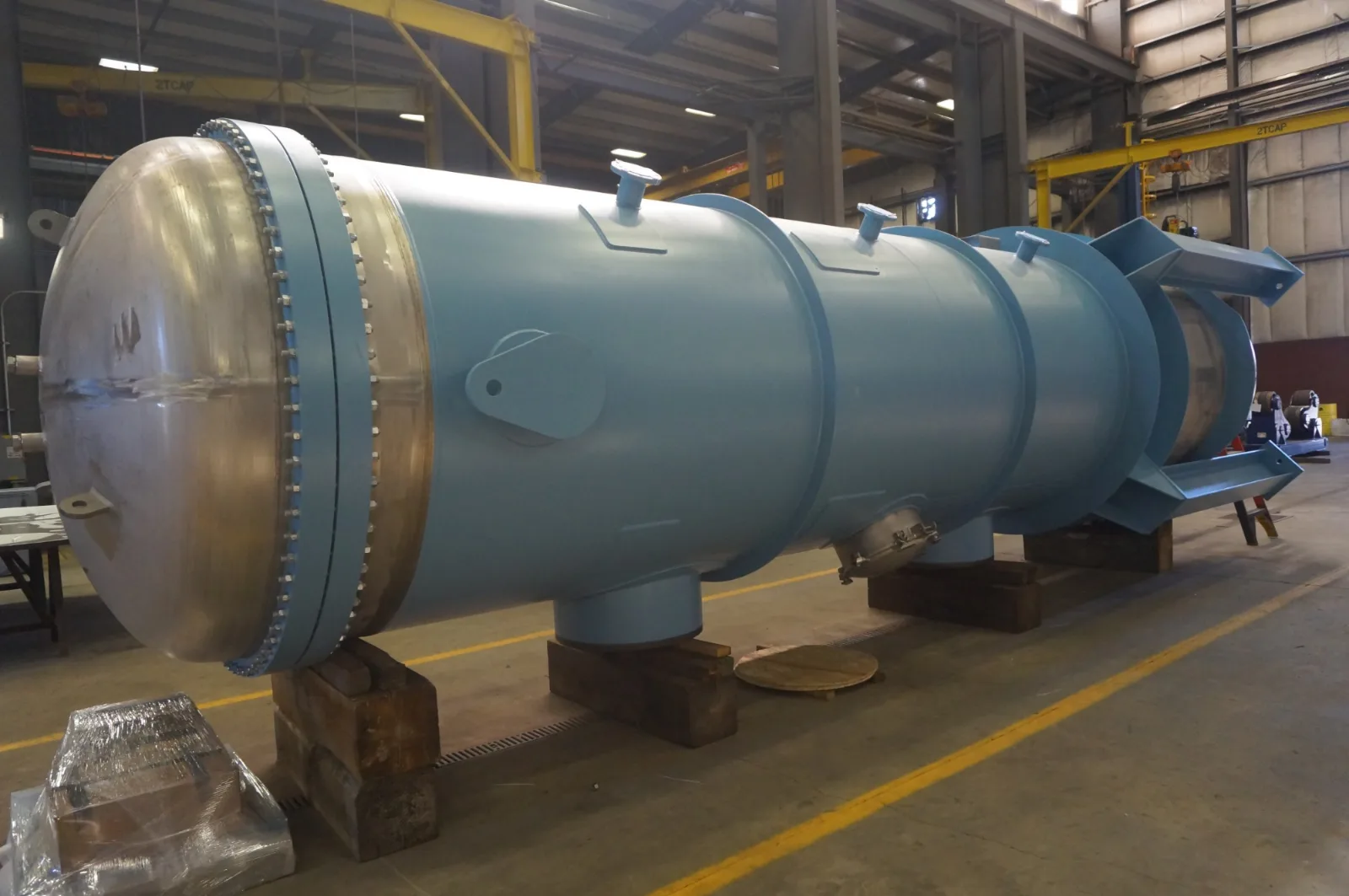
Exotic alloy heat exchangers for chemical service: Hastelloy, Inconel, titanium, and zirconium
What each alloy actually defeats, what destroys it, and why a specification that looked correct on paper still puts a tube bundle on the scrap pile in eighteen months.
Chemical process equipment questions.
What equipment does Harris Thermal fabricate for chemical processing?
Tubular and fixed-bed reactors, fluid-bed reactors, jacketed reactors, ASME Section VIII pressure vessels, process and mixing vessels, fractionation and distillation columns, reboilers, overhead condensers, shell-and-tube heat exchangers, replacement exchangers and tube bundles, falling-film and forced-circulation evaporators, scrubbers, cyclones, adsorber vessels, and storage and process tanks. Harris Thermal fabricates equipment for integration into your process; it does not supply the process design or the complete plant.
What specialty alloys and clad materials can Harris Thermal fabricate?
Carbon steel, stainless steels including 304L and 316L, duplex stainless, AL-6XN, Hastelloy, Inconel, Monel, titanium and other qualified specialty materials. For applications requiring corrosion-resistant wetted surfaces with a structural carbon-steel backing, Harris Thermal can fabricate equipment using customer-specified clad or explosion-bonded materials where appropriate to the design and fabrication requirements.
When should lethal service be considered or required?
Lethal service is a designation that comes from the process fluid, not from the fabricator. ASME Section VIII, Division 1 applies additional requirements — including full radiography of specified joints, post-weld heat treatment where required, and tighter joint-efficiency rules — to vessels containing substances considered lethal in low concentrations. Whether a given service meets that definition is determined by the customer, the EPC or the process-safety authority against the applicable code and jurisdictional requirements, not by us. Where a specification calls for it, Harris Thermal fabricates to the applicable ASME Section VIII lethal-service requirements, with the weld procedures, examination and documentation that designation carries. If you are unsure whether your service qualifies, that determination should be made with your process-safety team before design is fixed.
How are materials selected for corrosive chemical service?
Material selection follows the specified process conditions: chemistry, concentration, operating temperature and pressure, contaminants, any required corrosion allowance or corrosion rate, and whether the aggressive stream sees the shell side or the tube side. Cleanability and fouling behaviour matter where the service demands it. Harris Thermal does not independently select process metallurgy — that comes from your process data and corrosion requirements, and we translate it into practical exchanger and vessel construction: compatible tubes, tubesheets, shell, heads, internals and weld filler, in stainless steels, duplex and super duplex, nickel alloys, titanium or clad construction as the service requires. On some exchanger designs the more corrosive stream is routed to the tube side, because tubes and tubesheets can be built from a higher alloy without taking the entire shell to that alloy — but that is an application-dependent option, not a universal design rule, and it depends on pressure, temperature, fouling and cleaning access. See the materials we fabricate.
Can Harris Thermal fabricate reactors and process columns?
Yes. Tubular and fixed-bed reactors, fluid-bed reactors and jacketed reactors, and fractionation and distillation columns including column internals, reboilers and overhead condensers. Lethal service and cyclic service designs per ASME Section VIII, Division 1 are supported within qualified project scope, as are heavy-wall shells and large-diameter column sections.
Ready to spec your chemical process equipment?
Expanding resin capacity, upgrading solvent recovery, or building a new plant — send us the duty and the service conditions.